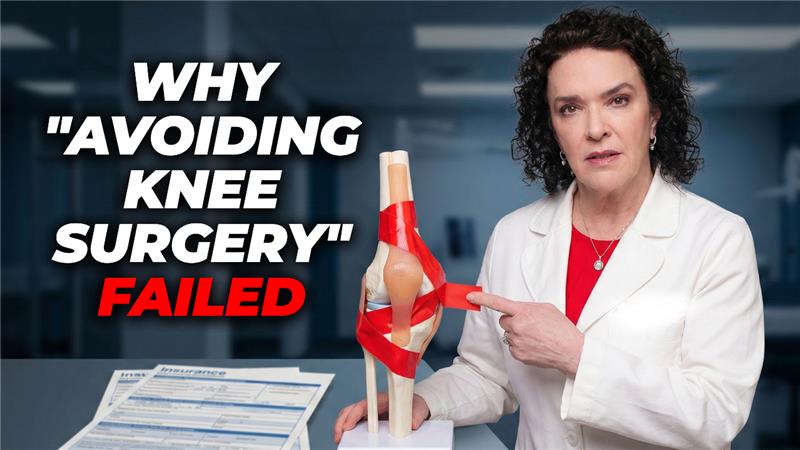
Avoiding Knee Surgery in 2025: What Actually Worked and What Failed Patients
In 2025, avoiding knee surgery started to feel like a moral victory. If someone found a way around it, they were celebrated. But for those who ended up needing surgery, it often felt like they’d failed somehow. That idea may have sounded inspiring, but it wasn’t always smart.
The reality is, some people skipped surgery and did great. Others? They avoided surgery and lost years of mobility and quality of life. So, what actually worked in 2025 for people trying to avoid knee surgery? What didn’t? And how can smarter thinking lead to better outcomes in 2026?
Episode Video
Avoiding Knee Surgery Is a Preference, Not a Treatment Plan
Choosing to avoid surgery isn’t automatically a bad decision, but it also isn’t a strategy by itself. In 2025, there were two types of patients. One group avoided surgery with a clear plan, and they improved. The other group avoided it just to avoid it, and their condition got worse. The difference wasn’t effort or motivation. It was clarity and good decision-making.

What Helped People Avoid Knee Surgery Successfully in 2025?
Patients who did well didn’t rely on one single solution. What worked was a smart combination of strategies. That included exercises tailored to their joint’s ability to handle stress, focused strength-building programs, managing weight and metabolism, and, only when it made sense, targeted biologic treatments like platelet-rich plasma or bone marrow therapy. One thing was clear, trying to use injections alone to fix a mechanical knee problem almost always failed.
When Avoiding Knee Surgery Backfires
A common story seen in clinics in 2025 was a patient desperate to avoid surgery. One such patient refused PRP and wasn’t a good candidate for bone marrow therapy either. The problem wasn’t the lack of treatment options, it was the structure of her knee. She had a torn ACL, unstable joint, meniscus damage, severe arthritis, obesity, and high levels of inflammation due to diet. In her case, injections weren’t helpful. The real issue was an unstable knee with too much biological stress. Offering her another injection wouldn’t be good care. It would be false hope.
What Went Wrong for Many Patients Trying to Avoid Surgery
A lot of people trying to avoid knee surgery in 2025 were failed in three big ways.
First, they were encouraged to try one procedure after another without ever asking if their knee was stable enough for anything to work.
Second, their recovery hit a wall because insurance cut off therapy too early. People were told they had “failed” conservative care when they hadn’t even finished it.
Third, necessary conversations about surgery were delayed. But waiting didn’t help, it hurt. Muscles got weaker, confidence dropped, and surgery, when it did happen, was harder than it needed to be.
When Avoiding Knee Surgery Actually Causes More Damage
Here’s the hard truth, avoiding knee surgery just to avoid it can be dangerous. Pain changes how people move. That change puts more stress on the joint, which speeds up damage. And as that damage gets worse, options become fewer. The only time it’s smart to avoid surgery is when function can still be preserved. If not, waiting becomes the real risk.
Avoid the Wrong Surgery, Not All Surgery
The smarter goal isn’t just avoiding surgery. It’s avoiding unnecessary surgery, or surgery that happens too soon or too late. It’s making sure strength, stability, and inflammation are under control before surgery is even considered. In some cases, the best next step isn’t another shot. It’s facing the facts about strength, weight, and knee stability. Sometimes, the right surgery at the right time gives someone back their freedom. That’s not a failure, that’s wisdom.
Final Thoughts
If you're heading into 2026 trying to avoid knee surgery, start by asking better questions. Is your pain from inflammation, a structural issue, or instability? Is your strength improving or getting worse? Are you making progress, or just hoping something will eventually work? Clear thinking always beats blind hope.
The real goal is to protect movement, confidence, and independence. Some people can do that without surgery. Others will need surgery to get there. The true failure isn’t choosing surgery. It’s losing years of your life to avoid something that was actually the right choice all along.
Frequently Asked Questions
Can knee surgery be avoided with physical therapy alone?
Sometimes, especially if the joint is stable and the issue is mild. But if there's significant damage or instability, physical therapy alone may not be enough.Are injections like PRP a good way to avoid knee surgery?
PRP can help in specific cases, but it's not a magic fix. It works best when combined with strength training and other strategies, and only in knees that are structurally sound.How do I know if delaying surgery is making my knee worse?
If your strength, mobility, or confidence is going down, that’s a red flag. Waiting too long can lead to more damage and fewer treatment options.Is avoiding knee surgery always the best choice?
Not always. Avoiding surgery is only smart when it helps preserve function. If it causes more harm or delays better treatment, it may be the wrong move.What should I do if conservative treatments aren't working?
Reevaluate your situation. Talk to a doctor about your knee’s structure, inflammation, and strength. Sometimes surgery, done at the right time, can be the key to getting your life back.
If you're ready to take control of your knee pain, click here to discover more about these five effective knee pain home treatments. With these simple steps, you can start your journey towards pain-free knees and a more active lifestyle.


