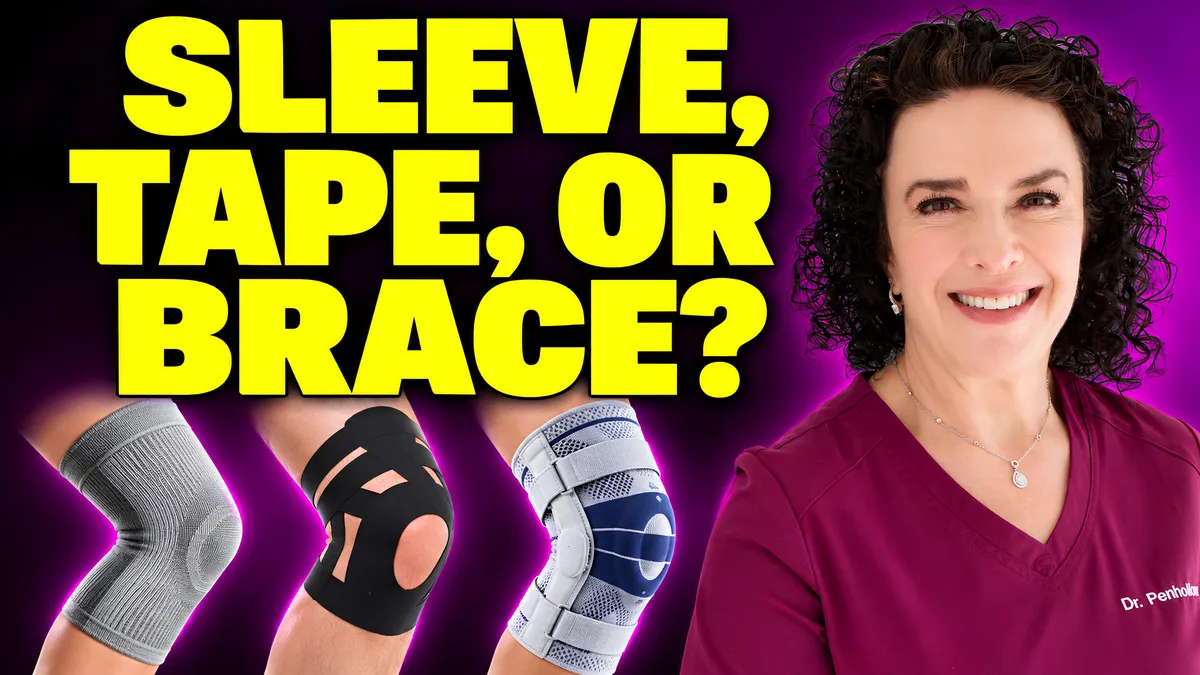
Sleeve, Tape, or Brace: How I Decide for Knee Pain
You know the moment. Your knee has been nagging you for weeks, and now you're standing in the pharmacy aisle staring at a wall of sleeves, tape, and braces. They all promise relief. None of them tell you which one you actually need.
The right knee support depends entirely on what's going on inside the joint. Pick wrong and you don't just waste money. You either under-support a real structural problem or over-brace something that only needed a little time and compression. This guide breaks down how a physician who specializes in spine, joint, and regenerative care thinks through the choice, so you can stop guessing.
Episode Video
Start With the Knee Itself: Inside vs. Outside
Before you compare products, you need to know which side of the joint is under stress. That single detail drives the decision far more than how bad the pain feels.
Medial (Inside) Knee Problems
The inside of the knee takes a lot of punishment, especially as the years add up. Common medial issues include:
Medial meniscus tears
Medial collateral ligament (MCL) strains
Wear-and-tear arthritis, which tends to show up on the inside first
Lateral (Outside) Knee Problems
The outside of the knee has its own set of trouble spots, including lateral collateral ligament (LCL) issues and lateral meniscus problems.
"That distinction is what actually drives what option makes sense, not just how bad the pain feels."
Option 1: The Compression Knee Sleeve
A compression sleeve is your entry-level tool. It's built for mild, general problems rather than a specific injury.
A sleeve offers two benefits. First, general compression, which helps manage mild swelling. Second, proprioceptive feedback, meaning it helps your brain sense where your knee is in space as you move.
Reach for a sleeve when you have a little swelling or general achiness that isn't pinned to one specific structure. If you can't point to one exact spot, a sleeve is often the right starting point.
Option 2: Kinesiology Taping
Taping steps in when the problem is specific. If you know the issue sits on the inside or the outside of the knee, tape can be applied directly to that side to offload it.
Targeted Strips vs. Pre-Cut Kits
Individual strips let you target the medial or lateral side precisely, and the technique differs for each. If you want broader support without cutting and placing separate strips, pre-cut kinesiology packs wrap the whole knee in one go.
Option 3: The Structured Knee Brace
This is where many men jump in too early, or wait too long. A structured brace is not for general soreness.
A brace makes sense when there's a known structural problem, such as a medial meniscus tear or a lateral meniscus issue with LCL involvement. In these cases, compression isn't enough. The joint needs mechanical "gapping," meaning it gets opened slightly to take strain off the damaged side.
A quality compartment brace has stabilization bars on both the inside and outside of the knee. Small pins, adjusted with an Allen wrench, let you dial in exactly how much the joint opens on one side or the other. A sleeve or tape simply can't do that.
Not every brace fits every problem. If your pain comes from kneecap (patellar) tracking, you need a completely different brace and a different taping pattern. Compartment braces are built specifically for medial or lateral problems.
Sleeve vs. Brace: Different Problems, Different Tools
Picture two knees, both already taped. One gets a sleeve for general support. The other gets a brace dialed in for a specific compartment. Neither choice is "better." Each one matches the job.
The goal isn't to pick the most impressive-looking gear. It's to avoid under-supporting a real structural issue, or overdoing it on something that just needs time to calm down and a bit of compression.
Final Thoughts
Staying active after 40 means taking care of the joints that carry you. The smartest knee support isn't the biggest or most expensive. It's the one that matches what's actually happening in your knee. Mild, general achiness calls for a sleeve. A specific inside or outside problem calls for tape. A known structural injury calls for a properly adjusted brace. And if you're not sure which camp you're in, see a doctor before you spend another dollar.
Want to see the difference in action? Watch or listen to the full podcast episode for a side-by-side demonstration of the sleeve, tape, and adjustable brace, plus links to dedicated taping walkthroughs for medial, lateral, and kneecap problems.
Frequently Asked Questions
How do I know if I need a knee sleeve or a knee brace?
A sleeve suits mild swelling and general achiness, while a structured brace is meant for a known structural problem like a meniscus tear or ligament injury.Can I use kinesiology tape for my knee pain?
Yes, tape works best when your pain is localized to the inside or outside of the knee so that specific side can be offloaded.Why does it matter which side of my knee hurts?
The side under stress, medial or lateral, determines which support will actually help, more than how severe your pain feels.Will a medial or lateral knee brace help my kneecap pain?
No, kneecap tracking problems need a different type of brace and a different taping pattern.When should I see a doctor instead of buying knee support on my own?
If you can't tell whether your pain is general soreness or a structural injury, a doctor's evaluation will save you from guessing.
If you're ready to take control of your knee pain, click here to discover more about these five effective knee pain home treatments. With these simple steps, you can start your journey towards pain-free knees and a more active lifestyle.


